Independent Lab Testing for Authentic Himalayan Shilajit
The best Shilajit starts with authenticity, purity, and transparency. Our Himalayan Shilajit is sourced from the high-altitude mountains of Gilgit-Baltistan and traditionally purified before undergoing independent laboratory testing for safety and composition. Our testing now extends beyond the standard heavy-metal panel of lead, arsenic, cadmium and mercury to include thallium and aluminum — providing a broader picture of elemental purity.
For over 50 years, our family has focused on preserving Shilajit in its natural resin form — without added fulvic acid, fillers, or unnecessary processing. Because when choosing authentic Shilajit, we believe where it comes from, how it is purified, and what the testing shows matter more than marketing claims.
Beyond the Standard Heavy-Metal Panel: Thallium & Aluminum Testing
Most Shilajit heavy-metal testing focuses on four commonly screened elements: lead, arsenic, cadmium and mercury. We believe transparency should go further.
In 2026, we expanded our independent elemental testing to include thallium (Tl) and aluminum (Al), giving consumers additional information about elements that are not always included in standard Shilajit testing panels.
Why thallium? Recent scientific research has specifically examined thallium in natural Shilajit and commercial Shilajit supplements, highlighting the importance of monitoring this element alongside more commonly tested heavy metals.
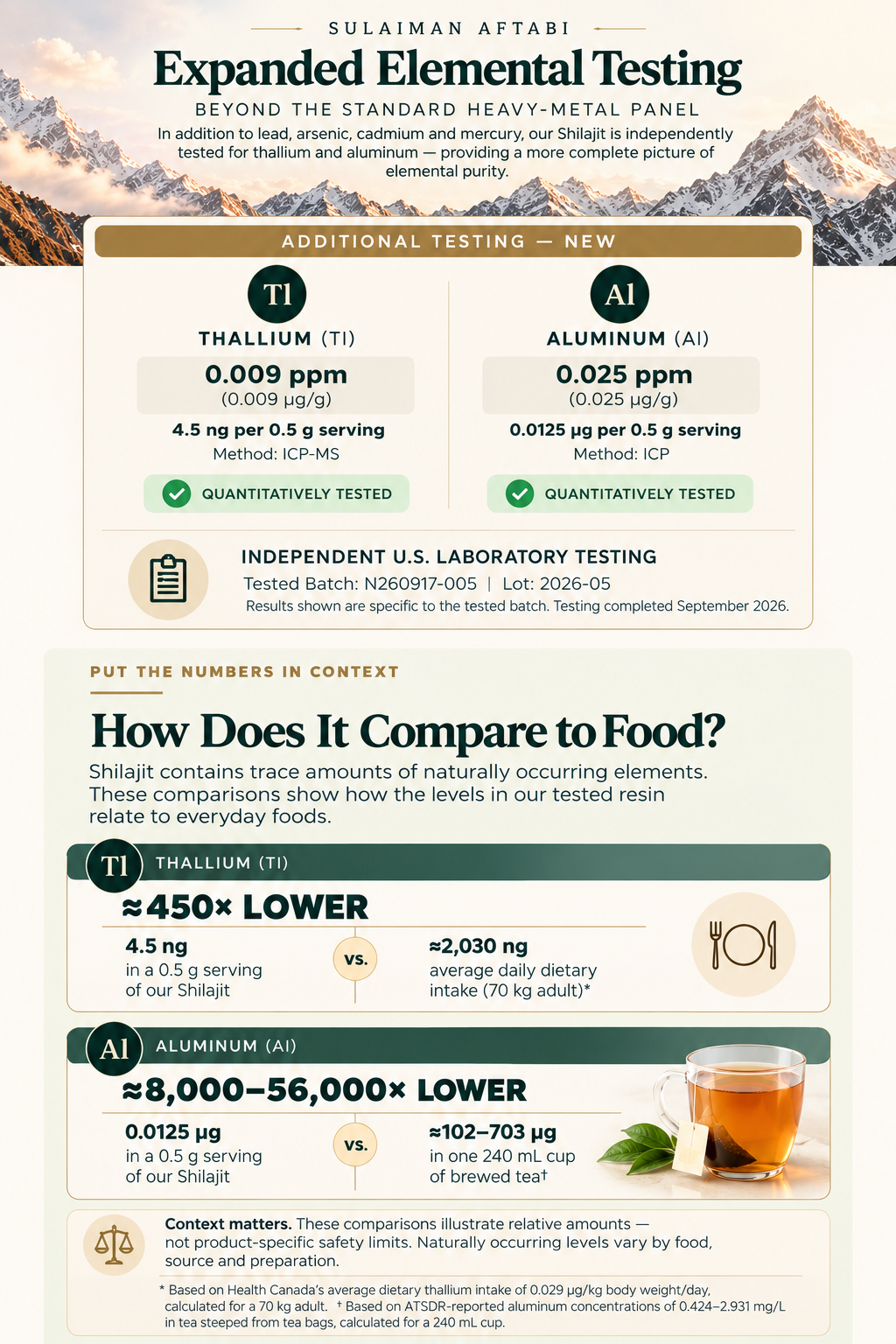
Our tested Shilajit Resin contained 0.009 ppm (0.009 µg/g) of thallium, measured by ICP-MS. At a 0.5 g serving, this equals approximately 0.0045 µg, or 4.5 nanograms, of thallium per serving. CA-9150139
For context, Health Canada reports an average dietary thallium intake of approximately 0.029 µg/kg of body weight per day. For a 70 kg adult, that is approximately 2.03 µg (2,030 ng) per day from the overall diet. Compared by amount, the thallium measured in a 0.5 g serving of our tested resin is approximately 450 times lower than that estimated average daily dietary intake.
Why aluminum? Aluminum is a naturally occurring element found in rocks, soil and mineral-rich environments. Because Shilajit originates in direct contact with geological material, we included aluminum in our expanded testing to provide a broader picture of its elemental composition.
Our tested Shilajit Resin contained 0.025 ppm (0.025 µg/g) of aluminum, measured by ICP. At a 0.5 g serving, this equals approximately 0.0125 µg of aluminum per serving. CA-9150139
For everyday context, published ATSDR data report aluminum concentrations of approximately 0.424–2.931 mg/L in tea steeped from tea bags. A 240 mL cup at those concentrations would contain approximately 102–703 µg of aluminum. Compared by amount, the aluminum measured in a 0.5 g serving of our tested resin is approximately 8,000–56,000 times lower.
Our independent elemental testing now includes:
✓ Lead (Pb)
✓ Arsenic (As)
✓ Cadmium (Cd)
✓ Mercury (Hg)
✓ Thallium (Tl) — NEW
✓ Aluminum (Al) — NEW
We expanded our testing because a “lab tested” badge should not be the end of the conversation. Consumers deserve to know what was tested, how it was tested, and what the laboratory actually found.
These comparisons provide context for the relative amounts measured and are not product-specific safety limits. Naturally occurring elemental levels can vary by food, source and preparation. Results shown are specific to the tested Shilajit Resin batch (Lot 2026-05). Testing completed September 2026.
Want to understand what these numbers mean? Read our full guide to thallium and aluminum in Shilajit →
Pure Science, Proven Safety
How Our Shilajit Compares to Daily Nutrition
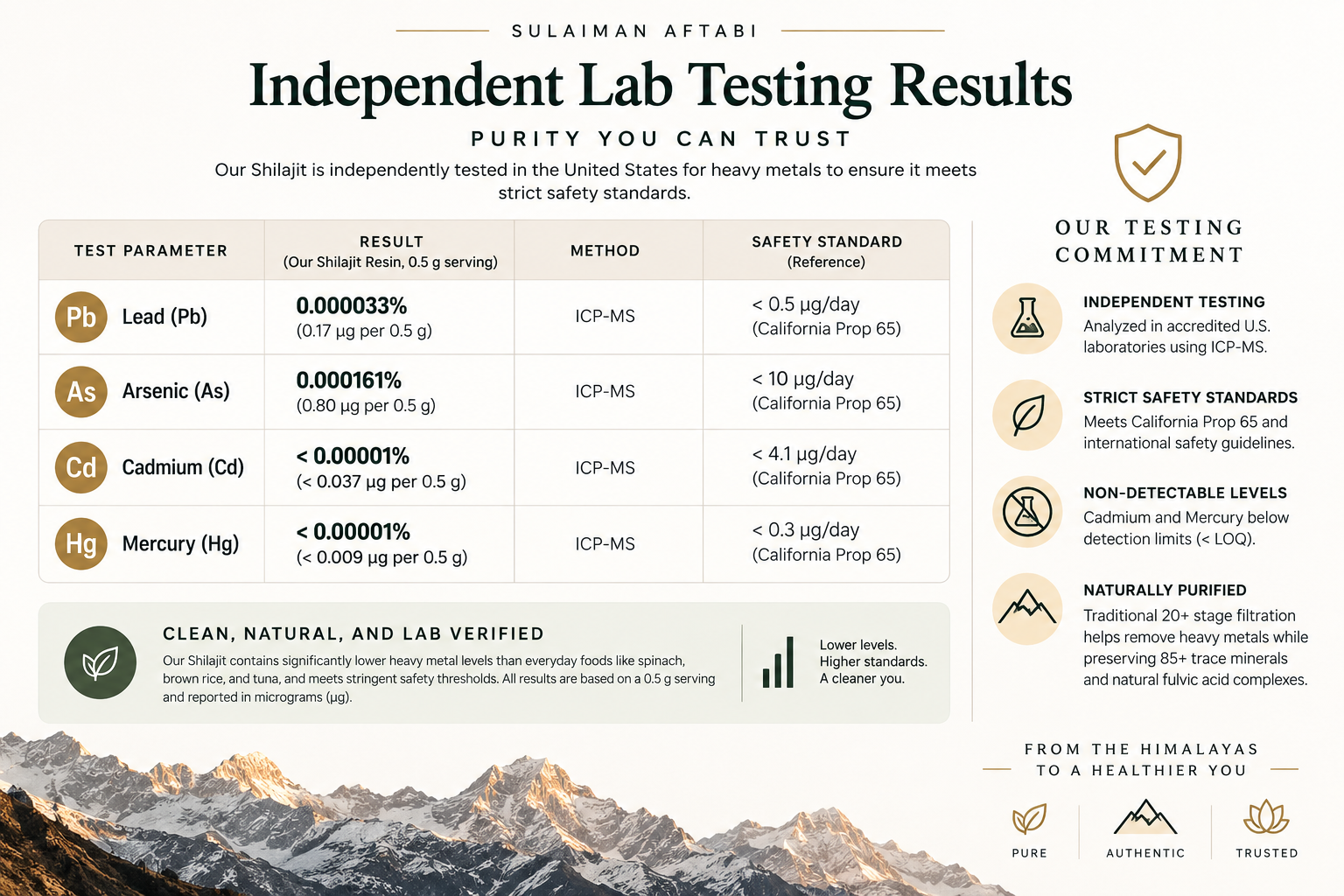
Tested Down to Parts-Per-Billion (ICP-MS): Every batch is independently audited in accredited US laboratories using Inductively Coupled Plasma Mass Spectrometry, a highly sensitive method capable of detecting trace elements at extremely low concentrations.
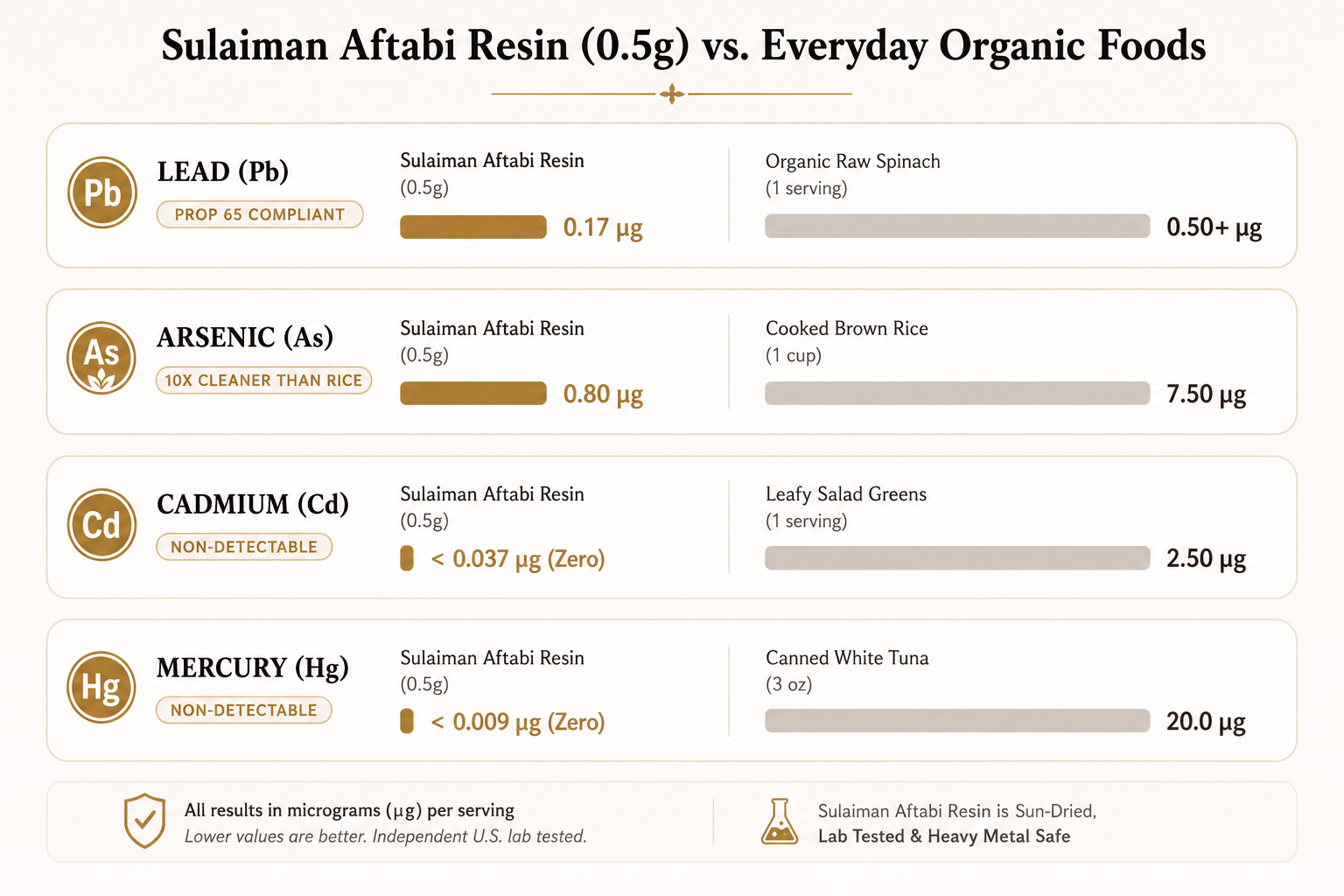
Cleaner Than Everyday Organic Groceries: At a daily 0.5g dose, our purified resin contains lower heavy metal concentrations than common healthy staples like organic spinach, brown rice, and leafy greens.
Strict California Prop 65 Compliance: Our lead levels sit at just 0.17 µg per serving—well below California's rigorous 0.5 µg/day safety threshold.
Below Quantification Limit: Cadmium and Mercury test below detectable laboratory limits (< LOQ), ensuring no toxic heavy metal accumulation in your body.
Purified Without Flash-Boiling: Our traditional 20+ stage filtration naturally precipitates heavy metals out while preserving 85+ active ionic minerals and organic fulvic acid complexes.
Understanding Fulvic Acid in Shilajit
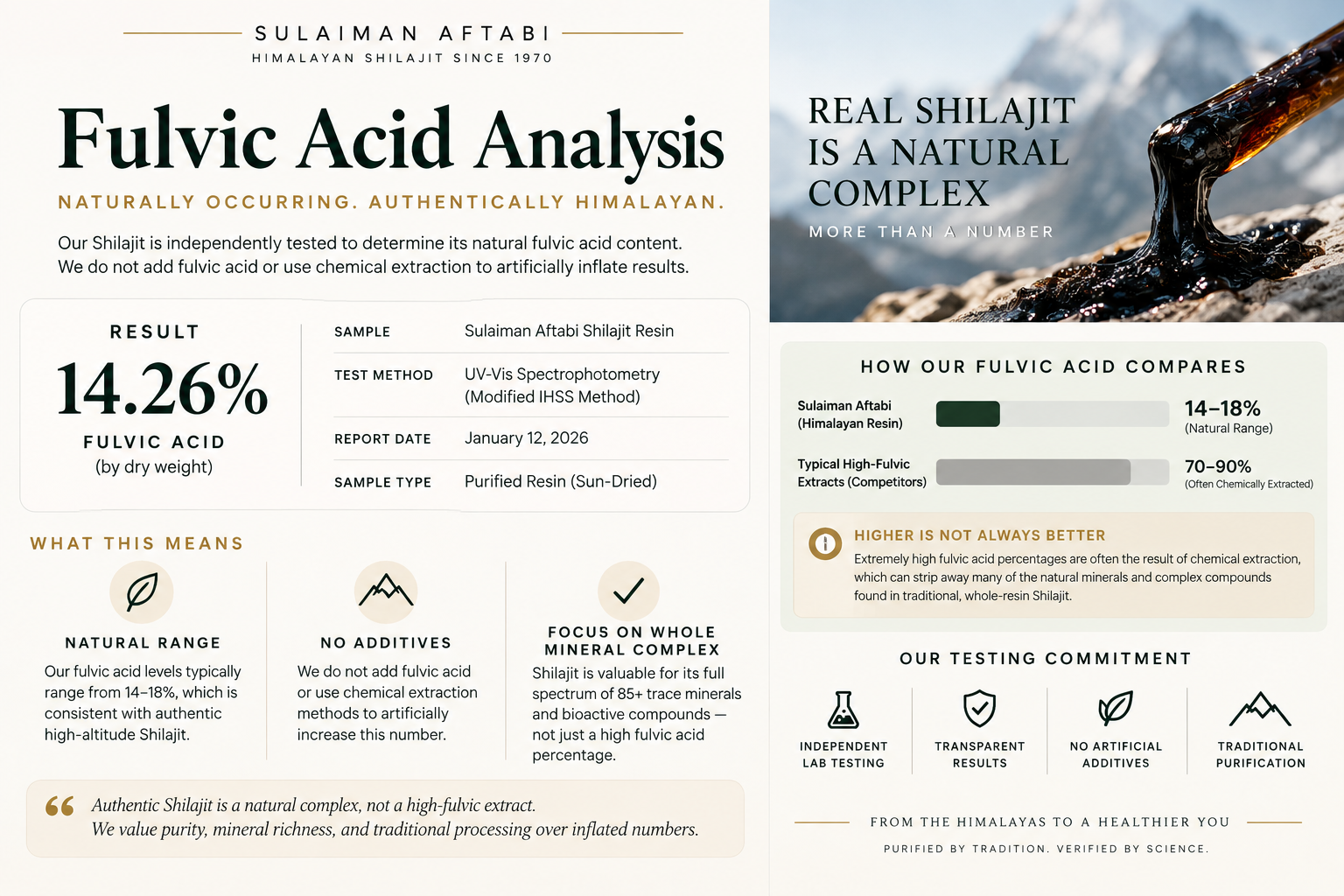
Fulvic acid is a naturally occurring component of authentic Shilajit. Our testing typically shows 14–18% fulvic acid, reflecting the natural composition of our high-altitude Himalayan resin.
What does this mean?
Natural Balance: The rest of the composition includes humic acid and over 85 trace minerals, offering a complete spectrum of nutrients.
No Added Fulvic Acid: We do not add isolated or synthetic fulvic acid to artificially increase the fulvic acid percentage of our resin.
Transparency Matters: Lab testing helps us share accurate information about what’s in each batch.
We believe in providing clarity and honesty about our Shilajit so you can make informed decisions for your wellness journey.
Questions about our testing? Contact us at info@sulaiman-aftabi.com for additional information about our testing program and results.
-
Authentic Shilajit should be evaluated by more than its color, texture or fulvic acid percentage. Look at its geographical origin, purification process, independent laboratory testing and transparency from the producer. Sulaiman Aftabi Shilajit is sourced from the high-altitude mountains of Gilgit-Baltistan and traditionally purified before independent testing.
-
When comparing Shilajit, consider its origin, purification method, independent heavy-metal testing and whether it is a whole resin or highly processed extract. The best Shilajit should provide transparency about both where it comes from and how it is tested rather than relying on a single purity or fulvic acid claim.
-
Shilajit is a naturally occurring substance formed in mineral-rich mountain environments, so trace elements can naturally be present. What matters is which elements are present and at what concentrations. This is why independent elemental testing is important. Our testing currently includes lead, arsenic, cadmium, mercury, thallium and aluminum, with results reported for the specific tested batch.
-
Independent testing helps verify the elemental composition and safety of Shilajit rather than relying solely on supplier claims. Testing can quantify heavy metals at very low concentrations and provide additional information about the natural composition of the resin.
-
Not necessarily. Fulvic acid is only one component of Shilajit. Authentic whole-resin Shilajit also contains humic substances and naturally occurring elements, and its composition varies according to geological source. We believe origin, purification, safety testing and overall composition are more meaningful than a high fulvic acid percentage alone.
-
Shilajit occurs in several mountainous regions of Asia. Sulaiman Aftabi Shilajit comes from the high-altitude mountains of Gilgit-Baltistan, Pakistan, where our family has sourced and traditionally prepared Shilajit for generations.
-
Yes. In 2026, we expanded our independent elemental testing to include thallium (Tl) in addition to lead, arsenic, cadmium and mercury. Our tested Shilajit Resin contained 0.009 ppm of thallium, measured by ICP-MS. At a 0.5 g serving, this equals approximately 0.0045 µg (4.5 nanograms) of thallium. Results are specific to the tested batch.
-
Yes. Our expanded elemental testing also includes aluminum (Al). The tested Shilajit Resin contained 0.025 ppm of aluminum, measured by ICP. At a 0.5 g serving, this corresponds to approximately 0.0125 µg of aluminum. We added aluminum testing to provide greater transparency about the elemental composition of our Shilajit. CA-9150139
-
Our current independent testing covers lead (Pb), arsenic (As), cadmium (Cd), mercury (Hg), thallium (Tl) and aluminum (Al). We expanded beyond the commonly tested four-element heavy-metal panel because we believe consumers should be able to see what was tested and what the laboratory actually found, rather than relying only on a general “lab tested” claim.