Thallium and Aluminum in Shilajit: What Our 2026 Lab Testing Found
Shilajit comes from a complex geological environment. That is part of what makes it unusual—but it also means responsible testing should look beyond attractive marketing claims such as “pure,” “natural,” or simply “lab tested.”
For years, Shilajit testing has commonly focused on four elements: lead, arsenic, cadmium and mercury. In 2026, we expanded our independent elemental testing to include two additional elements that consumers rarely see discussed on Shilajit labels or Certificates of Analysis: thallium (Tl) and aluminum (Al).
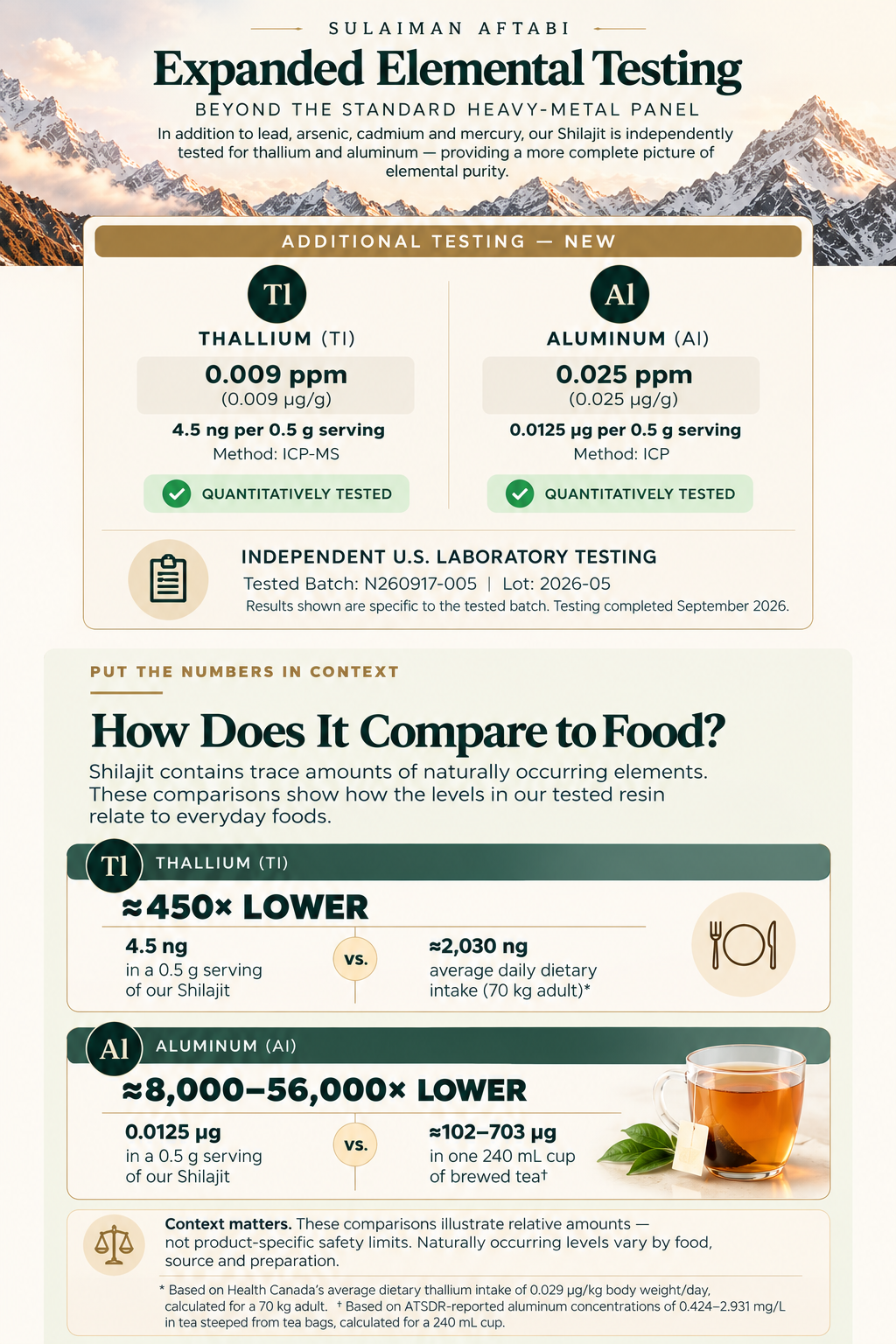
Quick answer: In our independently tested Shilajit Resin batch (Lot 2026-05), thallium measured 0.009 ppm by ICP-MS and aluminum measured 0.025 ppm by ICP. At a 0.5 g serving, those concentrations correspond to approximately 4.5 nanograms of thallium and 0.0125 micrograms of aluminum. These results are batch-specific and should be interpreted as measured concentrations—not universal safety limits.
We expanded testing because recent peer-reviewed research has specifically examined thallium in natural Shilajit and commercial supplements, while newer compositional studies continue to show that Shilajit can contain a geographically variable range of naturally occurring elements.
| Element | Result | Method | Approx. Amount in 0.5 g |
|---|---|---|---|
| Thallium (Tl) | 0.009 ppm | ICP-MS | 0.0045 µg / 4.5 ng |
| Aluminum (Al) | 0.025 ppm | ICP | 0.0125 µg |
Why Test Shilajit for Thallium?
Thallium is a naturally occurring element that can enter environmental materials through geological processes. Until recently, it received relatively little attention in discussions about Shilajit testing.
That changed in 2025, when a peer-reviewed study published in BMC Chemistry quantified thallium in natural Shilajit samples and commercial Shilajit supplements from multiple regions. The researchers reported thallium concentrations up to 0.226 µg/g in natural Shilajit and up to 0.5 µg/g in the commercial supplements they analyzed. They also reported that one supplement pill contained up to 0.095 µg of thallium and concluded that routine monitoring and standardized testing deserved greater attention.
View the peer-reviewed thallium study.
The study did not establish that all Shilajit contains the same amount of thallium, nor did it establish a universal Shilajit-specific safety threshold. In fact, the authors found substantial variation between samples and noted that geological conditions and origin can influence composition.
That variability is precisely why we believe the finished resin itself should be quantitatively tested.
Our Thallium Result: 0.009 ppm
Our tested Shilajit Resin contained 0.009 ppm of thallium, measured by ICP-MS.
Because 1 ppm in this context is equivalent to 1 µg/g, our result is also 0.009 µg of thallium per gram of resin. At a 0.5 g serving, that corresponds to approximately 0.0045 µg—or 4.5 nanograms—of thallium.
For scale, the highest concentration measured among commercial supplements in the 2025 BMC Chemistry study was 0.5 µg/g. Our tested concentration of 0.009 µg/g is approximately 56 times lower than that particular highest measured commercial sample.
Important: “56 times lower” is a concentration comparison. It does not mean “56 times safer.” The study’s highest measured value is not a regulatory safety threshold.
How Does 4.5 Nanograms Compare With Normal Dietary Exposure?
Thallium is not unique to supplements. Health Canada reports that food is the primary source of thallium exposure for Canadians and gives an average dietary intake across all age groups of 0.029 µg/kg body weight per day.
Read Health Canada’s assessment of thallium and its compounds.
For a hypothetical 70 kg adult, that average works out to approximately 2.03 µg, or 2,030 nanograms, per day from the overall diet. Our tested 0.5 g serving contains approximately 4.5 nanograms.
Compared by amount alone, the thallium measured in our 0.5 g serving is approximately 450 times lower than that estimated average daily dietary intake for a 70 kg adult.
This is an exposure comparison, not a product-specific safety limit. The U.S. EPA’s current IRIS assessment for soluble thallium salts states that information was reviewed but an oral Reference Dose was not estimated.
View the U.S. EPA IRIS assessment for soluble thallium salts.
Why Did We Also Test for Aluminum?
Aluminum is different from thallium. It is a common naturally occurring element in rocks, soils and geological materials. Because Shilajit develops in direct association with mountain rock and organic material, the presence of aluminum at some concentration is not inherently surprising.
A 2025 analysis published in ACS Omega of a native Himalayan Shilajit specimen reported aluminum at 0.02 ppm by MP-AES and emphasized the complex organic-inorganic character of the material.
Read the 2025 ACS Omega analysis of native Himalayan Shilajit.
A separate 2026 study analyzed 12 Shilajit samples from diverse geographical origins using ICP-MS and related techniques. The researchers reported clear variability across major, essential, toxic and rare-earth elements between samples, reinforcing that Shilajit’s elemental profile can differ by origin.
View the 2026 multi-origin Shilajit elemental study on PubMed.
Our Aluminum Result: 0.025 ppm
Our tested Shilajit Resin contained 0.025 ppm of aluminum, measured by ICP. That is equivalent to 0.025 µg/g, or approximately 0.0125 µg of aluminum in a 0.5 g serving.
Putting Aluminum Into Everyday Context
The U.S. Agency for Toxic Substances and Disease Registry (ATSDR) reports aluminum concentrations of approximately 0.424–2.931 mg/L in tea steeped from tea bags.
View the ATSDR Toxicological Profile for Aluminum.
Using a 240 mL cup, those concentrations correspond to approximately 102–703 µg of aluminum per cup of brewed tea. The measured aluminum in a 0.5 g serving of our tested resin is 0.0125 µg.
By amount, that is roughly 8,000–56,000 times lower than the amount calculated for a 240 mL cup of tea using the ATSDR-reported concentration range.
This comparison is about scale—not fear. It does not mean tea is unsafe, nor does it establish a Shilajit-specific safety threshold. Naturally occurring elemental concentrations vary by food, source and preparation.
For another point of reference, the Joint FAO/WHO Expert Committee on Food Additives (JECFA) established a provisional tolerable weekly intake (PTWI) of 2 mg/kg body weight for total aluminum. This applies to overall dietary exposure and is not a product-specific Shilajit limit.
View the WHO/JECFA evaluation for aluminum.
“Contains a Metal” Is Not the Same as “Contaminated”
This distinction matters with naturally derived materials. Shilajit’s composition reflects its geological environment, and recent research shows meaningful variation in elemental profiles between samples and geographical origins.
Detecting an element does not by itself tell you whether a product is unusually contaminated. The useful questions are:
Which element was tested?
What concentration was measured?
What analytical method was used?
How much product is consumed per serving?
What scientific or regulatory context actually applies?
That is also why phrases such as “heavy-metal free,” “zero metals,” or “100% toxin free” can be less informative than a quantitative laboratory result. Modern analytical instruments can detect extremely small concentrations. Transparency means showing the number and interpreting it carefully.
Why ICP-MS Matters for Thallium Testing
Our thallium result was determined using ICP-MS—inductively coupled plasma mass spectrometry, a highly sensitive technique used for trace-element analysis.
The U.S. Food and Drug Administration maintains an Elemental Analysis Manual for food and related products that includes ICP-MS methodology for arsenic, cadmium, chromium, lead, mercury, thallium and other elements in food matrices.
View the FDA Elemental Analysis Manual.
Why We Expanded Beyond the Traditional Four-Metal Panel
Lead, arsenic, cadmium and mercury remain important elements to test, and they remain part of our elemental testing. But newer research suggests that stopping at those four can leave unanswered questions about the broader elemental composition of Shilajit.
Our expanded elemental testing therefore now includes lead, arsenic, cadmium, mercury, thallium and aluminum.
This does not mean every element should be treated identically. It means consumers deserve more information than a generic “lab tested” badge.
View our independent Shilajit lab testing and elemental results.
What Our Results Do—and Do Not—Prove
Our laboratory results tell us something specific: for the tested Shilajit Resin batch, thallium measured 0.009 ppm and aluminum measured 0.025 ppm.
They do not prove that every Shilajit batch everywhere has the same composition. They do not establish new regulatory safety limits. And they do not justify claiming that naturally occurring elements are literally absent simply because their concentrations are very small.
This is why we identify these results as batch-specific.
What Should Consumers Look for in Shilajit Testing?
When a Shilajit company says its product is “lab tested,” one of the most useful questions is: Lab tested for what?
A meaningful report should make it possible to determine the element tested, the quantitative result, the unit of measurement, the analytical method when available, and which batch or lot was analyzed.
This is one reason we created our Shilajit Lab Reports page: to explain not simply that we test, but what we test and what the results mean.
For a broader guide to evaluating sourcing, resin form, processing, claims and testing, see our guide on how to tell if Shilajit is real.
Why This Matters to Sulaiman Aftabi
Our family has worked with Shilajit for more than five decades. Traditional experience matters to us—but so does modern analytical testing.
Traditional sourcing and purification tell us how we prepare Shilajit. Modern laboratory analysis helps tell us what is actually in the finished resin.
As analytical research on Shilajit continues to develop, we intend to keep asking a simple question: What information would we want to see if we were buying this product ourselves?
For thallium and aluminum, the answer was clear.
We wanted the numbers. So we tested for them.
Frequently Asked Questions
Does Shilajit contain thallium?
Research shows that thallium can occur in both natural Shilajit and commercial Shilajit supplements, although concentrations vary substantially between samples. A 2025 peer-reviewed study reported concentrations up to 0.226 µg/g in the natural Shilajit samples and up to 0.5 µg/g in the commercial supplements it analyzed.
Is Sulaiman Aftabi Shilajit tested for thallium?
Yes. Our expanded elemental testing includes thallium. The tested Shilajit Resin batch measured 0.009 ppm, equivalent to approximately 4.5 nanograms in a 0.5 g serving, using ICP-MS. You can see the broader testing context on our Shilajit Lab Reports page.
Is aluminum naturally present in Shilajit?
Aluminum can occur as part of Shilajit’s natural inorganic and mineral composition. Published analysis of native Himalayan Shilajit and multi-origin Shilajit research support the broader point that elemental composition can vary between samples and origins.
How much aluminum was found in Sulaiman Aftabi Shilajit?
The tested batch measured 0.025 ppm of aluminum, equivalent to approximately 0.0125 µg in a 0.5 g serving. See our Lab Reports page for additional testing information.
Should Shilajit be tested only for lead, arsenic, cadmium and mercury?
Those four elements remain important, but recent peer-reviewed research has specifically highlighted thallium as another element worth monitoring in Shilajit. Our expanded elemental testing therefore includes lead, arsenic, cadmium, mercury, thallium and aluminum.
What does 0.009 ppm of thallium mean?
In this context, 0.009 ppm is equivalent to 0.009 µg of thallium per gram of resin. In a 0.5 g serving, that corresponds to approximately 0.0045 µg, or 4.5 nanograms.