Sun-Dried vs. Hybrid & High-Heat Shilajit: The Truth Behind Authentic Himalayan Resin
Quick Summary: Authentic Himalayan shilajit is purified using pure glacier meltwater and dried naturally under ambient sunlight over 45 to 90 days. Mass-market manufacturers rely on high-heat industrial boiling, while boutique retailers frequently use "low-heat hybrid" dehydrators to speed up production. Only 100% unheated solar concentration preserves shilajit's full bioactive matrix without thermally degrading fulvic acid and humic complexes.
Why Extraction & Drying Methods Determine Shilajit Quality
If you are researching how to choose the best shilajit resin, you have likely noticed prices ranging from $15 to over $60 per jar.
While elevation and geological origin matter, the single biggest differentiator in quality is how the raw rock exudate is processed and dried after harvesting.
The Industry Secret: Over 90% of commercial shilajit on the market relies on industrial boiling or "low-heat hybrid" dehydrators to evaporate water quickly. True 100% sun-dried resin takes up to 90 days per batch and cannot be mass-produced.
Understanding the difference between high-heat boiling, low-heat hybrid drying, and 100% solar concentration ensures you get a product that retains its natural potency, organic trace elements, and cellular delivery capacity.
From Mountain to Jar — The Glacier Water Solar Process
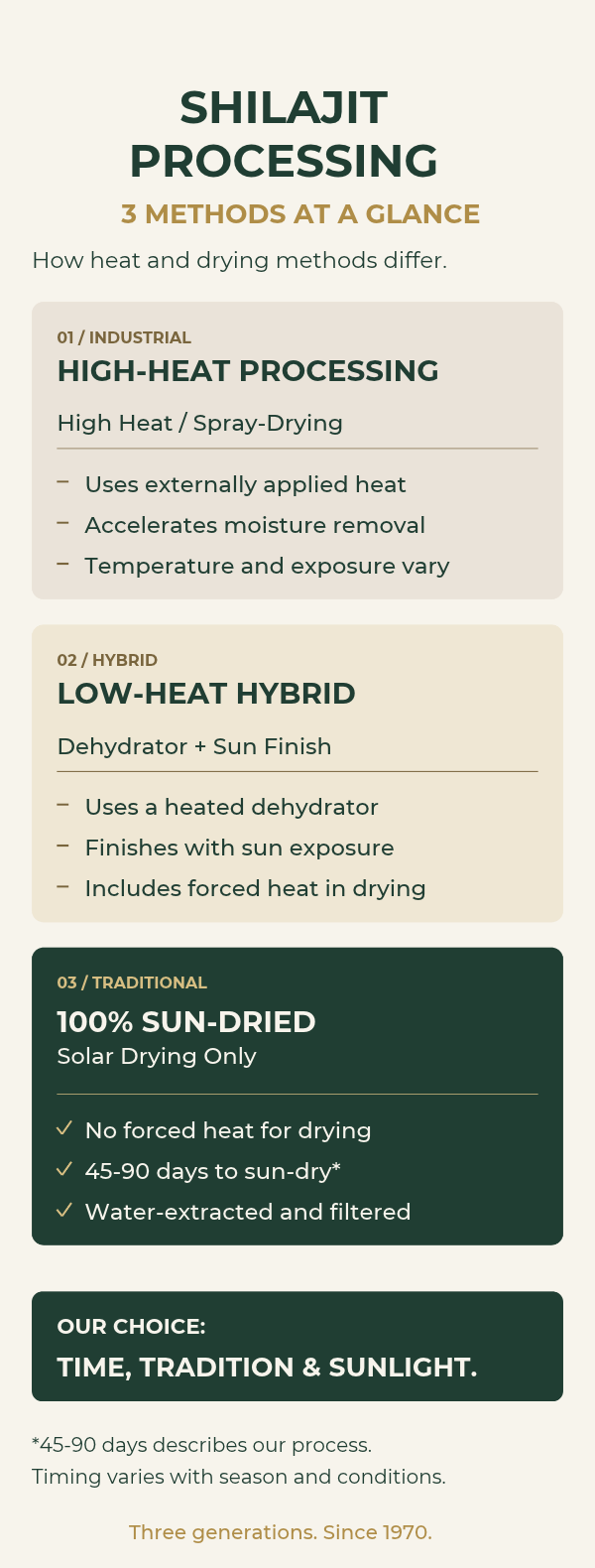
The 3 Shilajit Processing Methods Explained
When raw shilajit is hand-collected from high-altitude rock faces in Gilgit-Baltistan, it must be dissolved in liquid to separate the organic resin from sand, gravel, and rock sediment. Once filtered, the liquid must be evaporated.
The method used to remove that water dictates whether the bioactive compounds survive intact.
Mass-Market Industrial Processing (High-Heat Boiling)
The Process: Factories boil raw material in large metal vats at high temperatures or pass it through industrial spray-dryers to turn liquid into dry powder or paste within hours.
The Drawback: Sustained heat denatures delicate organic complexes, breaks down humic substances, and creates a scorched, burnt aftertaste.
Common Forms: Cheap powders, gummies, and liquid drops. Learn more about how these compare in our breakdown of the different types of shilajit.
Premium Retailer Processing (The "Low-Heat Hybrid" Shortcut)
The Process: To produce larger volumes without waiting months, many boutique retailers dissolve raw rock and place the liquid into electric dehydrators, vacuum pans, or low-heat drying chambers. Once the bulk of the water is removed artificially, the resin is given a short "sun finish."
The Drawback: While superior to high-heat boiling, even low artificial heat subjects delicate bioactive compounds to prolonged thermal stress, altering the natural molecular state of the resin.
The Result: A good product, but one created using industrial speed-drying to meet commercial distribution targets.
Traditional Craftsman Processing (100% Pure Solar Concentration)
The Process: Purified liquid resin is placed in shallow trays and allowed to evaporate exclusively under direct mountain sunlight and ambient air for 45 to 90 days. Zero artificial heat, ovens, or dehydrators are used at any point.
The Result: A dense, glossy, temperature-sensitive resin that preserves the full spectrum of fulvic acid, humic substances, and trace minerals exactly as nature intended.
Glacier Water Extraction in Gilgit-Baltistan
The liquid used during purification is just as critical as the drying process. Tap water or chemical solvents can introduce municipal chemicals, fluorides, or residual solvents into the raw resin.
At Sulaiman Aftabi, our family has worked directly with harvesters in Gilgit-Baltistan since 1970. Our extraction protocol uses no chemicals or piped municipal water:
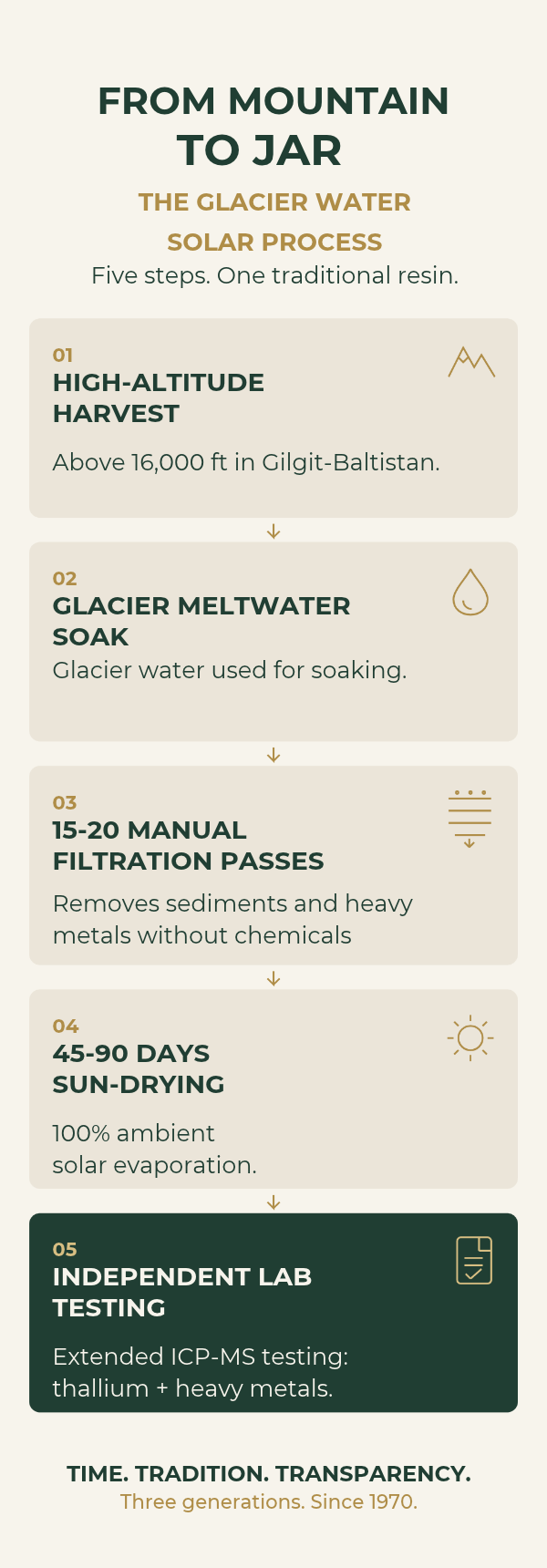
High-Altitude Sourcing: Raw exudate is hand-collected from rock crevices above 14,000 feet in the Karakoram range during warm summer months.
Glacier Meltwater Extraction: Raw rock formations are washed and soaked in pure, mineral-dense mountain glacier meltwater to dissolve the resin away from rock sediment.
Multi-Stage Manual Filtration: The liquid undergoes 15 to 20 fine filtration cycles to clear physical debris without synthetic clarifiers or forced heating.
45 to 90 Days of 100% Solar Drying: The purified liquid sits under direct sunlight until a pliable, amber-black resin forms naturally.
By avoiding heat and relying on natural solar concentration, we preserve the full matrix of organic compounds without inflating percentages. Read our analysis on the truth about fulvic acid percentages to understand why standardized lab percentages can be misleading.
Scientific Literature & Advanced Safety Standards
While marketing claims are common in the supplement industry, published peer-reviewed research and laboratory documentation provide objective evidence of purity.
SCIENTIFIC LITERATURE BRIEF: HEAVY METAL & THALLIUM MONITORING
Published Study: BMC Chemistry (2025) — "Elemental Profiling & Thallium Detection in Natural Shilajit Matrices"
Key Finding: Commercial heavy-metal panels screening only for Lead, Arsenic, Cadmium, and Mercury miss toxic trace elements like Thallium (Tl) present in geological rock formations.
Industry Recommendation: Routine extended ICP-MS laboratory screening beyond standard Prop 65 4-metal panels.
Because shilajit is harvested directly from geological rock formations, heavy metal screening is mandatory. Standard regulatory panels only screen for four elements: Lead, Arsenic, Cadmium, and Mercury.
However, modern analytical research shows that standard 4-metal panels leave critical blind spots. The 2025 BMC Chemistry study identified detectable levels of thallium in various commercial shilajit samples, calling for expanded analytical testing across the industry.
To ensure absolute safety, Sulaiman Aftabi tests every batch through accredited third-party laboratories for an expanded elemental profile:
Standard Heavy-Metal Panel: Lead, Arsenic, Cadmium, Mercury
Extended Contaminant Panel: Thallium and Aluminum
Batch Consistency: Verifiable Certificates of Analysis (COA) corresponding to your exact jar batch number.
Review our full lab findings in our detailed report on our 2026 thallium and aluminum lab testing findings.
| Feature | Industrial High-Heat Shilajit | Premium Retailer Hybrid Shilajit | Sulaiman Aftabi Traditional Shilajit |
|---|---|---|---|
| Sourcing Region | Unspecified / Mixed Brokers | General Himalayan Range | Gilgit-Baltistan (Direct Since 1970) |
| Extraction Liquid | Tap Water / Chemical Solvents | Standard Water Extraction | Pristine Glacier Meltwater |
| Drying Method | High-Heat Boiling / Spray-Drying | Hybrid: Low Heat + Sun Finish | 100% Unheated Solar Concentration |
| Processing Time | 24–48 Hours | 5–10 Days | 45–90 Days (Pure Sun-Drying) |
| Lab Testing Scope | Basic or Missing | Standard 4 Heavy Metals | Extended Panel (Includes Thallium & Aluminum) |
| Physical Integrity | Powder, Gummy, or Dry Paste | Pliable Resin | Authentic Temperature-Sensitive Resin |
Physical Markers of 100% Sun-Dried Resin
To verify that your resin was sun-dried without artificial heating, look for these natural physical characteristics:
Temperature Responsiveness: In cold weather, pure sun-dried resin hardens into a glass-like solid. Warm it in your hand, and it becomes soft and pliable.
Complete Water Solubility: A pea-sized portion dissolves completely in warm water or tea, leaving no gritty sand or sediment at the bottom of the glass.
Earthy Herbal Aroma: Authentic resin has a distinct, smoky-herbal aroma and a bold, naturally bitter mineral taste—never a burnt, rubbery, or sweet flavor.
For a complete step-by-step physical verification guide, read our detailed post on 9 ways to identify real vs. fake shilajit.
Frequently Asked Questions
What is the difference between sun-dried shilajit and high-heat shilajit?
Sun-dried shilajit uses natural solar radiation over 45 to 90 days to gently evaporate water from liquid resin without exceeding ambient mountain temperatures. High-heat shilajit uses boiling vats, vacuum evaporators, or dehydrators to dry the product in hours, which degrades heat-sensitive organic compounds, fulvic acid complexes, and dibenzo-α-pyrones.
Why is glacier water better for shilajit extraction?
Glacier meltwater from high-altitude mountain peaks is naturally pure, free from municipal chemicals like chlorine or fluoride, and rich in natural trace minerals. Using glacier water during extraction ensures the raw shilajit resin is dissolved cleanly without introducing municipal contaminants or chemical solvents.
What is hybrid drying in shilajit production?
Hybrid drying is a manufacturing shortcut where raw shilajit liquid is partially dried using electric dehydrators or low-heat warming chambers to speed up production before being given a brief finish under the sun. While milder than industrial boiling, hybrid drying still applies artificial thermal stress to the resin.
How do I verify if my shilajit has been tested for heavy metals?
Ask the manufacturer for a batch-specific Certificate of Analysis (COA) from an independent, ISO-accredited laboratory. Ensure the COA tests not only for standard heavy metals (lead, arsenic, cadmium, mercury) but also for extended geological contaminants like thallium and aluminum.
Is sun-dried shilajit better than shilajit gummies or powders?
Yes. Shilajit powders and gummies are produced using high-heat spray-drying or chemical binding agents that alter the natural mineral matrix. Sun-dried resin remains in its raw, unadulterated state, preserving its complete bioactive profile and natural cellular transport capability.
Experience 100% Sun-Dried Glacier-Extracted Shilajit
By combining more than five decades of family sourcing heritage in Gilgit-Baltistan, pristine glacier water extraction, 100% unheated sun-drying, and expanded analytical lab testing, Sulaiman Aftabi delivers gold-grade Himalayan shilajit directly from the source.
👉 Shop 100% Sun-Dried Glacier-Extracted Shilajit Resin Today
Author & Editorial Authority
Written by the Sulaiman Aftabi Research Team
Sourcing, purifying, and testing authentic Gilgit-Baltistan shilajit since 1970. Our educational content draws on over 50 years of family sourcing heritage, published scientific research literature, and independent batch-level laboratory analysis.